Open post
Fighting Fraud and Waste in Home Health Starts Before the Claim

Preventing Fraud and Waste in Home Health Starts Before the Claim

Preventing Fraud and Waste in Home Health Starts Before the Claim

tango helps health plans make sure home health care is appropriate before money is wasted by managing the patient journey clinically, not just analyzing claims afterward.

As federal policymakers intensify efforts to combat fraud, waste, and abuse in Medicare, home health has emerged as a top area of focus. In May, the Centers for Medicare and Medicaid Services (CMS) imposed a six-month nationwide moratorium on the enrollment of new home health agencies, citing concerns about fraud risks and the need to prevent new high-risk providers from entering the Medicare program.

But for Medicare Advantage plans, who already have established fraud, waste, and abuse programs, the more immediate opportunity is less about detecting fraud and more about making sure the home health benefit is being used appropriately, ensuring that services are medically necessary, properly utilized and delivered by high-quality providers.

That requires asking questions before and during care, not simply analyzing a claim retrospectively. Is the home health agency properly licensed, accredited where applicable and in good standing? Does the referral support a need for skilled
home health services? Is the patient improving? Are continued visits medically necessary? Is home health still the right setting

Those questions do not replace a health plan’s existing fraud, waste and abuse safeguards. They add another layer of protection; one built around specialized knowledge of how home health should work, supporting quality outcomes and what appropriate care should look like over time.

Start Before the First Home Health Visit

This is where specialized home health management can add value. In delegated arrangements, tango has visibility across the provider network, the referral, authorization process, claims and the episode of care. That makes it possible to evaluate utilization at several points throughout the patient journey before it becomes simply another paid claim.

Step One: Validate the Agency

The first line of defense is knowing who is providing the care. tango credentials participating home health agencies to verify that they meet applicable requirements, are in good standing and have the required Medicare credentials. tango also builds and manages networks around agencies that can reliably accept referrals, start care promptly and deliver high-quality outcomes.

Step Two: Validate the Referral

When a referral comes in, tango verifies member eligibility, reviews the requested services and determines whether home health is the appropriate setting. A new referral shortly after a previous episode ended may be entirely appropriate, but it also raises an important question: Why is the patient returning to home health so soon?

Step Three: Validate Care as it Continues

Once care begins, tango clinicians review requests as the episode unfolds and evaluate whether the patient is making expected progress. Reviewers use Medicare coverage criteria, clinical guidance and information about the patient’s condition and progress to assess whether services remain medically necessary and appropriate as needs change.

For example, a patient recovering from knee replacement may initially need home-based physical therapy but eventually progress to the point where outpatient therapy is more appropriate. The goal is not to establish predetermined visit limits. It is to make sure services remain clinically appropriate, medically necessary and aligned with the patient’s evolving needs throughout the episode of care.

Claims Tell Part of the Story. Clinicians Provide the Context.

Medicare Advantage plans already have claims analytics, compliance programs and other tools to identify potential fraud, waste and abuse. Specialized home health management complements those capabilities by adding clinical context. A pattern that looks unusual in claims data may be entirely appropriate for one patient and warrant closer review for another.

Understanding the difference requires professionals who know the home health benefit, expected recovery patterns and the patient’s clinical circumstances. That expertise helps health plans distinguish between care that is appropriate and utilization that may warrant further review.

tango-looking beyond claims

The Goal Is the Right Care, Not Less Care.

The same scrutiny must work in both directions. Ending home health too soon can jeopardize recovery, lead to an emergency department visit or increase the risk of a hospital readmission. Good oversight is also about matching services to what the patient needs as those needs change.

At its best, home health is about helping patients recover, regain independence, and move safely to the next stage of care. That requires a focus on outcomes, patient progress, and timely intervention, not simply the volume of services delivered. When providers, delegates, and health plans work toward those shared goals, patients benefit, and limited home health resources can be directed to those who need them most.

Helping More Patients Access the Care They Need

The consequences extend beyond healthcare spending. Home health operates within a constrained workforce, with nurses, therapists and aides in short supply in many communities. When services continue beyond what is medically necessary, those limited clinical resources may be unavailable for other patients waiting to receive the services they need.

Ensuring care remains aligned with a patient’s clinical needs can address two challenges at once. It helps promote appropriate utilization while preserving clinical capacity for patients who truly need home health. Protecting access and ensuring care remains clinically appropriate are not competing priorities; done well, they reinforce one another.

A Different Layer of Protection for Health Plans

Fraud investigations, claims analytics and compliance programs will remain essential tools for identifying suspicious billing patterns, program integrity concerns and potential misconduct. But much of the opportunity in Medicare Advantage home health happens earlier, through the everyday decisions that determine who provides the care, whether a referral is clinically appropriate, how a patient is progressing and when it is time to transition.

Health plans’ existing fraud, waste and abuse teams can identify unusual patterns and investigate potential concerns. Specialized home health management adds another layer and a different perspective: clinical insight into how care is progressing, whether services remain aligned with the patient’s needs and when a concern warrants escalation to the health plan.

The goal is to make sure patients receive the right care, at the right time, in the right place.

For health plans, that means promoting access to care while supporting appropriate utilization of services and resources. Help patients who need home health receive it. Help those who are ready to transition, transition safely. And make sure the benefit continues to deliver value, effective care, quality outcomes, and patient progress throughout the episode.

Open post
tango Home Health Spending blog

Home Health Costs a Quarter of a SNF Stay. Plans That Manage It Capture the Difference.

Home Health Costs a Quarter of a SNF Stay. Plans That Manage It Capture the Difference

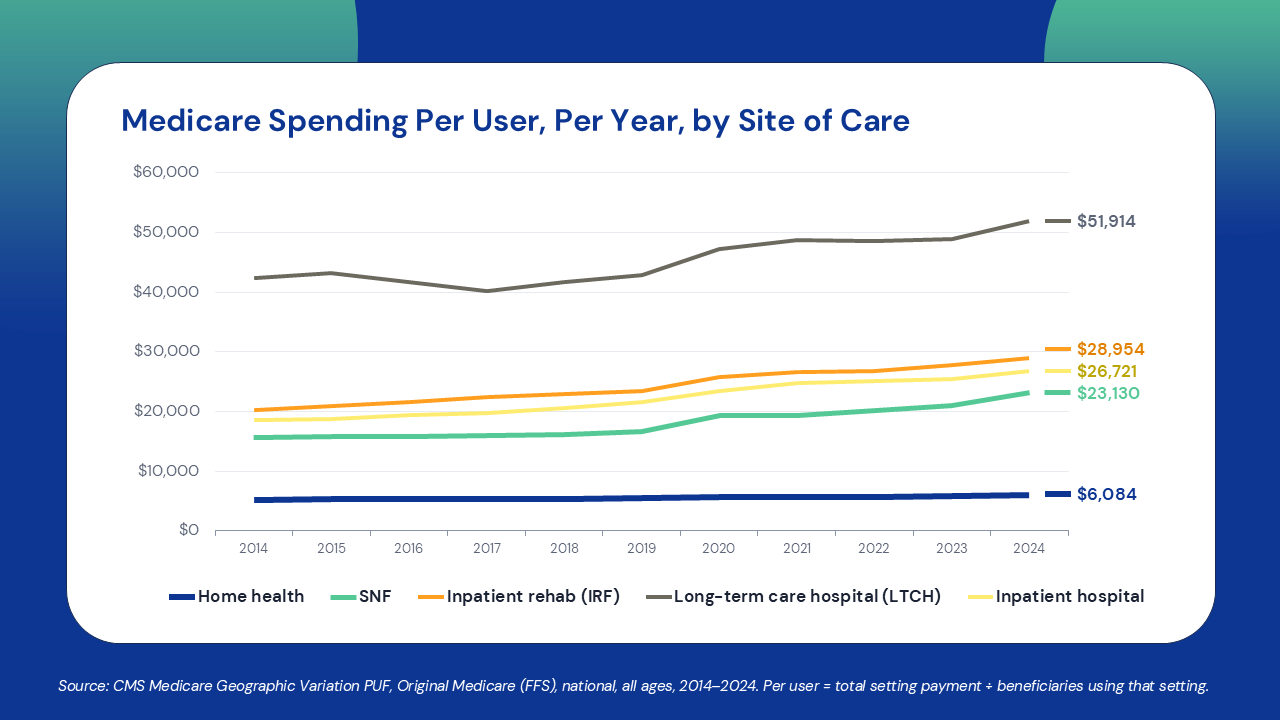
Medicare spends about $6,000 a year for patients who receive home health services. That same patient would cost more than $23,000 if they stayed in a skilled nursing facility (SNF) — nearly four times as much. Inpatient rehabilitation (IRF) runs higher still, and long-term care hospitals (LTACH) even higher than that.

As medical costs climb, the lowest-cost option in post-acute care should be getting easier to use when it is clinically appropriate. Instead, Medicare’s latest data point shows the value of home health is growing, even as the system still lacks a reliable way to make home the default when home is the preferred place for recovery.

The Centers for Medicare and Medicaid Services (CMS) recently updated data on spending and utilization in traditional Medicare for 2024. These data contain information on costs and use across a variety of settings and offer a powerful glimpse of what is driving Medicare spending. The data stretches from 2014 to 2024, giving a decade-long view of trends over time. Because Medicare Advantage plans do not report data in the same way, the clearest view of spending comes from the fee-for-service side. But since Medicare Advantage benchmarks and payment are tied to fee-for-service spending, those trends still matter deeply for plans.

The cost gap is real — and it keeps widening

Between 2014 and 2024, Medicare’s cost per skilled nursing facility user grew 48%. Inpatient rehab grew 43%. Overall Medicare spending grew 39% over that same time. The average home health user? Just 17%.

A SNF stay now costs 3.8 times what home health costs per patient, up from 3.0 times a decade ago. As the most expensive settings are rising fastest, the value of the least expensive one only improves.

Medicare Spending Per User Per Year

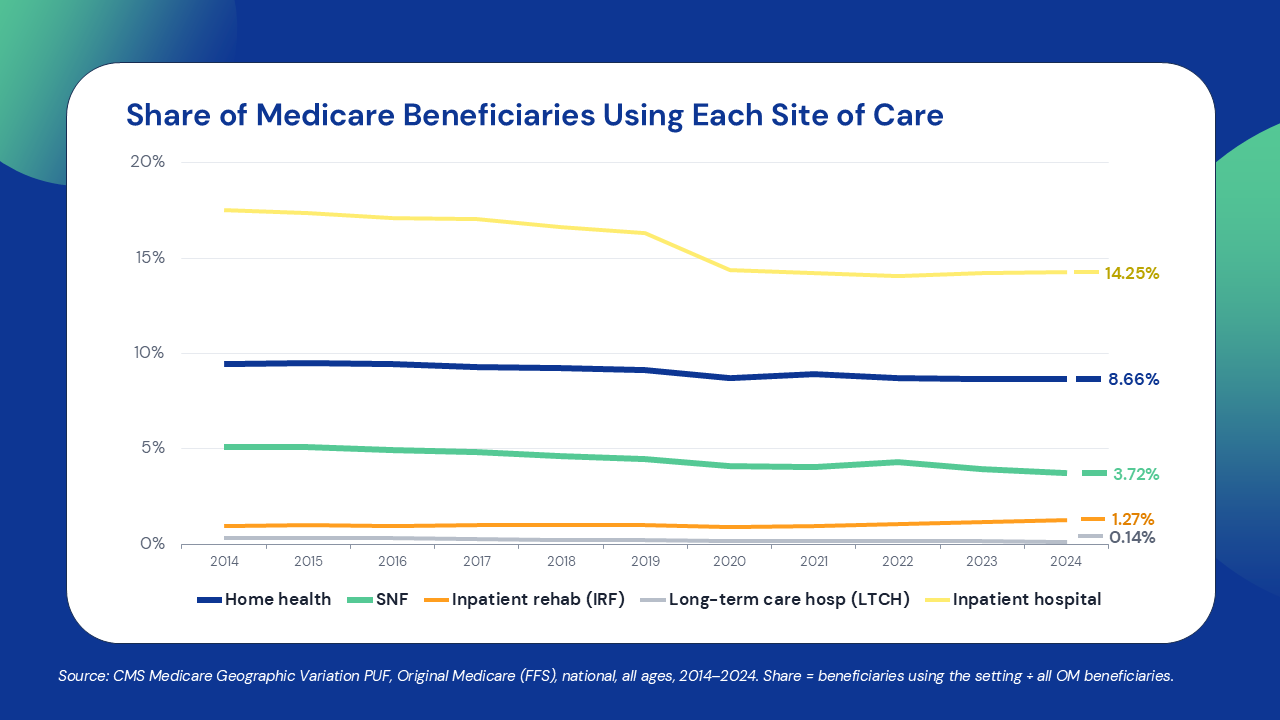
Home health accounts for less than 4% of total Medicare spending. And yet, when a patient leaves the hospital, the system does not always make it easy to choose the lowest-cost appropriate site of care.

To be clear, home health is not suitable for everyone. Some patients are sicker or more fragile and require more than a nurse or therapist visiting a few times a week. For them, a higher-cost, more hands-on setting may be appropriate.

But the spending gap should force health plans to think more critically about how to make the home a better option for recovery when it’s appropriate.

Just over 1 million traditional Medicare beneficiaries had a SNF stay in 2024. If even 10% of them had been cared for at home instead, Medicare could have saved more than $1.7 billion — the difference in cost between the two settings.

On top of the cost and quality arguments, there is the human one: where do people want to recover? For many patients, the answer is home, sleeping in their own bed, eating their own food, surrounded by familiar people and routines.

Share of Medicare Beneficiaries Using Each Site of Care

The problem is the pathway, and tango is different

tango is a delegated, risk-bearing post-acute partner that helps Medicare Advantage plans manage the home health benefit in a way that expands access, aligns incentives, and improves outcomes.

tango steps in when the post-acute decision is being made. It qualifies referrals, confirms eligibility, reviews clinical information, coordinates with providers, and routes patients to high-performing home health agencies. The goal is to enable care, improve outcomes, and lower the total cost of care.

tango also changes the economics for providers. Instead of paying only for volume, tango uses value-based contracts that reward agencies for outcomes. Savings are shared with the providers doing the work, creating a stronger incentive to accept the referral, start care quickly, prevent avoidable readmissions, and support recovery at home.

tango manages the home health benefit for nearly 2 million Medicare Advantage members. The 30-day readmission rate for tango-managed patients runs about 10%, compared to a national average of about 15% — roughly one-third lower. That delivers lower costs and better outcomes, in the same move.

The takeaway

Home health is the lowest-cost setting in post-acute care, it continues getting cheaper relative to every alternative, and patients are asking for it. The only thing missing is the management layer that gets the right people there safely.

Health plans that build it will generate savings and improve quality at the same time. The ones that do not will keep paying four times more for care that, ten to twelve percent of the time, did not need to happen at all.

If you are rethinking your post-acute strategy, we would welcome a conversation.

Open post
MA Rate Notice - Featured Image

Medicare Advantage Rates Are Tightening. Post-Acute Strategy Matters More Than Ever.

Medicare Advantage Rates Are Tightening. Post-Acute Strategy Matters More Than Ever

The recently released Medicare Advantage (MA) rate notice reinforces a reality health plans already feel every day: profit margins are under increasing pressure, and they must better manage the health of their members to survive.

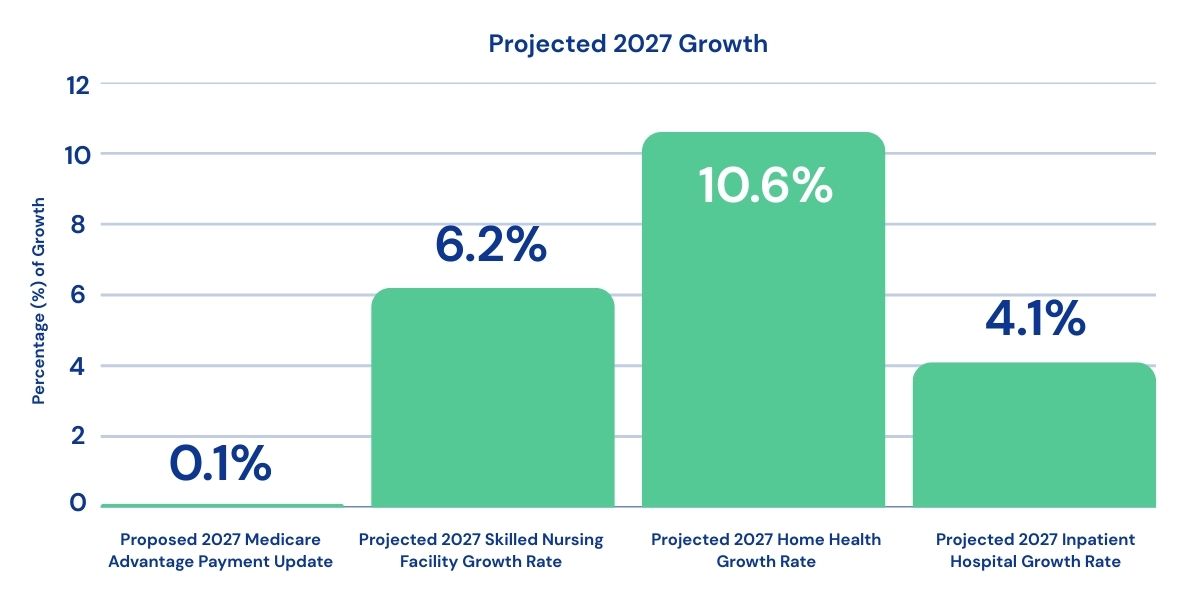
Overall, the Centers for Medicare and Medicaid Services (CMS) proposed a near-flat (0.1%) update in MA payment rates in 2027, even as underlying medical costs continue to rise. At the same time, CMS data shows one area growing faster than every other category in Medicare: post-acute care — particularly home health.

Post-acute spending is driving a disproportionate share of growth in Medicare spending. Home health spending is projected to increase by more than 10%—roughly 2.5x the growth rate of inpatient care. Skilled Nursing Facility (SNF) spending is projected to grow by more than 6%, about two percentage points faster than hospital care. Because MA benchmarks are based on traditional Medicare spending, growth in post-acute Fee-For-Service (FFS) costs directly flows into plan bids, even when rates themselves remain constrained.

As home health utilization grows, home health care access is a struggle for Medicare Advantage enrollees. Workforce shortages, reimbursement pressure, and increasing administrative friction mean agencies are more selective about the patients they accept. In many markets, plans are seeing longer placement times, narrower networks, and rising provider abrasion.

Together, those trends underscore how quickly utilization and dollars are shifting downstream — even as inpatient growth remains comparatively modest — and access challenges are emerging at the same pace.

With more scrutiny to risk adjustment, plans can’t rely on rate tightening or blunt utilization controls to generate savings. Instead, CMS appears to be reinforcing a shift toward care management and total cost control, particularly in high-growth areas like post-acute care. That combination creates a clear signal for Medicare Advantage leaders. Health plans must actively manage post-acute spending or continue to see margins and outcomes to erode.

CMS 2027 Growth Rates
Source: CMS Office of the Actuary, Advance Notice of Methodological Changes for CY 2027

Home health is growing, and it’s not slowing down

According to CMS, growth in home health spending is being driven by both utilization and unit costs, reflecting broader trends of an aging population, pressure to discharge patients sooner, and strong patient preference for recovering at home.

For years, post-acute care has been managed largely through utilization controls like eligibility checks, visit caps, and administrative hurdles designed to limit volume. But those approaches were built for a different era.

Today’s challenge is delivering better care:

  • Are members getting into home health quickly after discharge?
  • Are referrals going to high-quality providers who can prevent avoidable readmissions?
  • Are incentives aligned so agencies are rewarded for outcomes, not volume?
  • Is care being coordinated across settings, or fragmented across vendors?

When post-acute care is treated as a transactional benefit rather than a managed episode, plans lose the trust of patients, providers disengage, and avoidable costs show up later, often as readmissions, ED visits, or extended facility stays.

A shift toward coordinated, value-based post-acute care

Instead, MA plans need a different solution: tighter integration, better care management, and accountability for total cost of care.

This is where tango’s model aligns squarely with the moment. By managing post-acute referrals at the point of discharge, tango reduces placement delays and increases access to high-performing providers.

Rather than relying on utilization management alone, tango actively manages post-acute episodes end-to-end. That means:

  • Improving access by reducing placement delays and directing referrals to high-performing providers
  • Aligning incentives through value-based, episodic reimbursement rather than volume-driven payments
  • Reducing friction for plans and providers by integrating referral management, utilization oversight, and claims into a single delegated model
  • Driving better outcomes through real-time clinical oversight and accountability across the episode of care

For plans, the result is a more sustainable way to manage one of the fastest-growing areas of spend without sacrificing quality or member experience. For providers, it creates predictability, partnership, and incentives that reward good care.

The takeaway for MA leaders

Margin protection won’t come from across-the-board cuts or tighter gates alone. It will come from smarter care delivery, especially in high-growth areas like post-acute care.

Plans that invest now in coordinated, value-based post-acute strategies will be better positioned to absorb cost pressure, improve outcomes, and compete on member experience. Those that don’t may find that unmanaged growth quietly undermines both financial performance and quality metrics.

Home health isn’t just a cost center. Managed well, it’s a lever for better care and a competitive advantage.

Turning Post-Acute Care into a Competitive Advantage

tango partners with Medicare Advantage plans to transform post-acute care from a cost center into a performance driver. Our delegated model improves placement speed, aligns providers around outcomes, and delivers predictable savings, all while protecting member access.

If you’re rethinking your post-acute strategy in light of the 2027 rate notice, we’d welcome a conversation.

Open post
tango-iheart

Leading with Purpose: Brian Lobley on Why Home-First Care Is the Future

Leading with Purpose: Brian Lobley on Why Home-First Care Is the Future

Brian Lobley, chief executive officer of tango, was recently featured on CEOs You Should Know, an iHeartMedia podcast that spotlights executives shaping the future of their industries. The conversation highlighted Brian’s leadership qualities and underscored why tango’s growth, strategy, and impact are resonating across healthcare.

As home-based care moves to the center of the healthcare delivery system, industry leaders are increasingly looking to executives who can navigate complexity, scale responsibly, and keep patients at the center of innovation. Brian’s leadership at tango reflects that moment.

A Leadership Style Built on Impact

During the conversation, Brian reflected on a career that spans technology, strategy, and operations across some of healthcare’s largest organizations, including senior leadership roles at Independence Blue Cross, one of the nation’s largest regional health plans. There, he worked at the intersection of payer strategy, technology modernization, and provider relationships, experience that shaped his perspective on how incentives drive outcomes at scale. What ultimately drew him to tango, he shared, was the ability to see impact more clearly and more quickly.

Brian’s perspective shapes how tango operates today. He described how he emphasizes mission and culture while encouraging teams to continuously improve processes across people, technology, and operations. For example, he starts every meeting with a patient story and personally meets with every new hire.

Brian has fostered a culture where innovation and execution go hand in hand. The result is a company that moves fast without losing sight of why the work matters.

Scaling a Home-First Model That Works

Under Brian’s leadership, tango has grown rapidly by leaning into a simple but powerful premise: when clinically appropriate, patients want to recover at home, and outcomes are better when they do.

On the podcast, Brian described tango’s “home-first” approach to post-acute care, which prioritizes timely, high-quality transitions from hospital to home. By aligning incentives across health plans and providers and operating in value-based payment arrangements, tango helps reduce readmissions, improve access to care, and lower total cost of care. tango prioritizes access, its “secret sauce”, and patients are 30% less likely to be readmitted to the hospital or visit an emergency room if they’re seen at home within two days of a hospital discharge.

tango’s model is scaling quickly. tango has expanded its footprint from four states in early 2025 to 10 states by 2026, growing the number of Medicare Advantage lives it serves while maintaining high standards for quality and member experience.

Recognition That Reflects Momentum

Being featured on an iHeart podcast alongside leaders from across industries is third-party validation of tango’s trajectory and Brian’s role in shaping it. As policymakers, payers, and providers rethink how post-acute care should work and its role in managed care, voices like Brian’s are helping define what comes next.

For tango, the takeaway is clear: the market is paying attention. The challenges in home health—access gaps, workforce shortages, and rising costs—are real. But so is the opportunity to solve them with smarter, value-based approaches that put patients first.

As Brian put it during the interview, healthcare is ultimately a team sport. tango’s continued growth reflects what’s possible when leadership, incentives, and purpose are aligned around getting patients the right care, in the right place, at the right time.


Listen to the Podcast

Open post

Q+A with Wendy Coyle, tango’s Chief People Officer

Q+A with Wendy Coyle, tango’s Chief People Officer

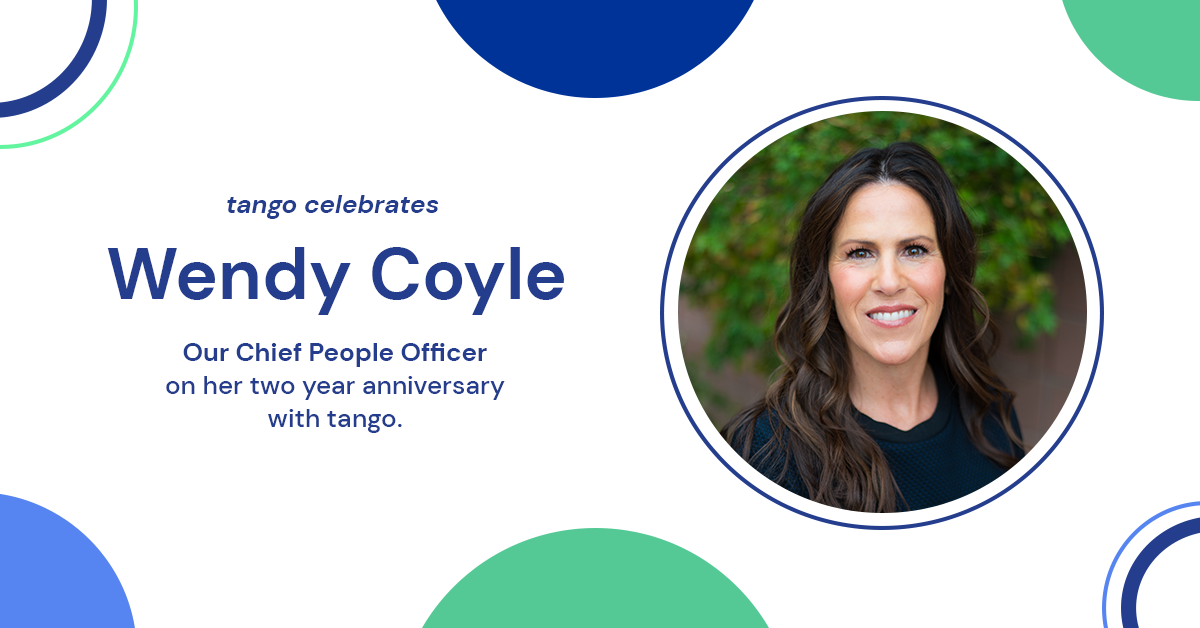
Wendy Coyle Chief People Officer

February 2024 marks Wendy Coyle's two-year anniversary as tango's Chief People Officer. In a recent interview, we had the opportunity to explore Wendy's impactful contributions over the past two years, particularly in the realm of Diversity, Equity, and Inclusion, and her enthusiasm for shaping a robust company culture.

Tell us about your role at tango!
Wendy: I lead the strategic function of human capital and the employee experience to meet the needs of the business, overseeing our Human Resources and talent functions. This encompasses a spectrum from hiring, onboarding, employee relations, management, rewards, retention, and development, to culture, compliance, diversity, equity, and inclusion efforts. Additionally, I manage benefits, payroll, and compensation.

What led you to join tango?
Wendy: I did not start my career in this space but I have a passion for healthcare since my mom was a nurse. I knew I wanted to help people just like her but I was not interested in needles, ha! Therefore, when I moved to Arizona, my first role was with a health plan, which eventually led me to tango. Even though I am not patient facing, I am part of the journey in patient care. When I met our CEO and COO, I knew this was where I wanted to be. I love having the opportunity to ensure our teams are connected to our overall mission.

What initiatives at tango are you especially proud of?
Wendy: I am proud of the teams that I have built and the success in our employee engagement, diversity and culture. tango was featured in Vistria’s 2023 Annual Impact Report for our efforts in DEI with our respect to recruitment. The HR team also started “Coffee Chats” this year, and our first conversation was centered around Black History Month. We can’t wait to have more!
We established our Culture Committee in 2022, which is comprised of dedicated individuals who are passionate about fostering an inclusive workplace. We work together to organize monthly events and initiatives. We’ve done everything from an online Secret Santa exchange to creating chat channels to discuss various topics such as Chinese New Year, Valentine's Day, Presidents Day, St. Patrick's Day, and more. The aim is to create a fun, engaging, and entertaining environment where everyone feels valued, heard, and included.

How have you kept a strong company culture with most of the team being remote?
Wendy: Even though the majority of our company works across the country, from the west coast to the east coast and in 26 states, we feel like a family. We are very intentional with getting together regularly in person to foster connection and collaboration. Our executive and senior leadership teams meet in person quarterly, and we love having teams visit our tango headquarters in Phoenix, AZ. When together, we always make sure to enjoy time with each other by doing team building events. It keeps us connected!
We also initiated “tango talks” in the middle of 2023 to improve company culture since we are 95% remote. The purpose of these talks is to get everyone to learn more about their leadership teams. Our CEO, Brian, attends every discussion. We have received great reviews from employees who attend. Everyone seems to value the quality, personal time with our CEO and leadership team, as well as getting to connect with team members they don’t interact with as frequently.

What are you most excited about when it comes to tango in 2024?
Wendy: I am excited to be a part of our continued growth and what we are becoming!

Open post
tango chart

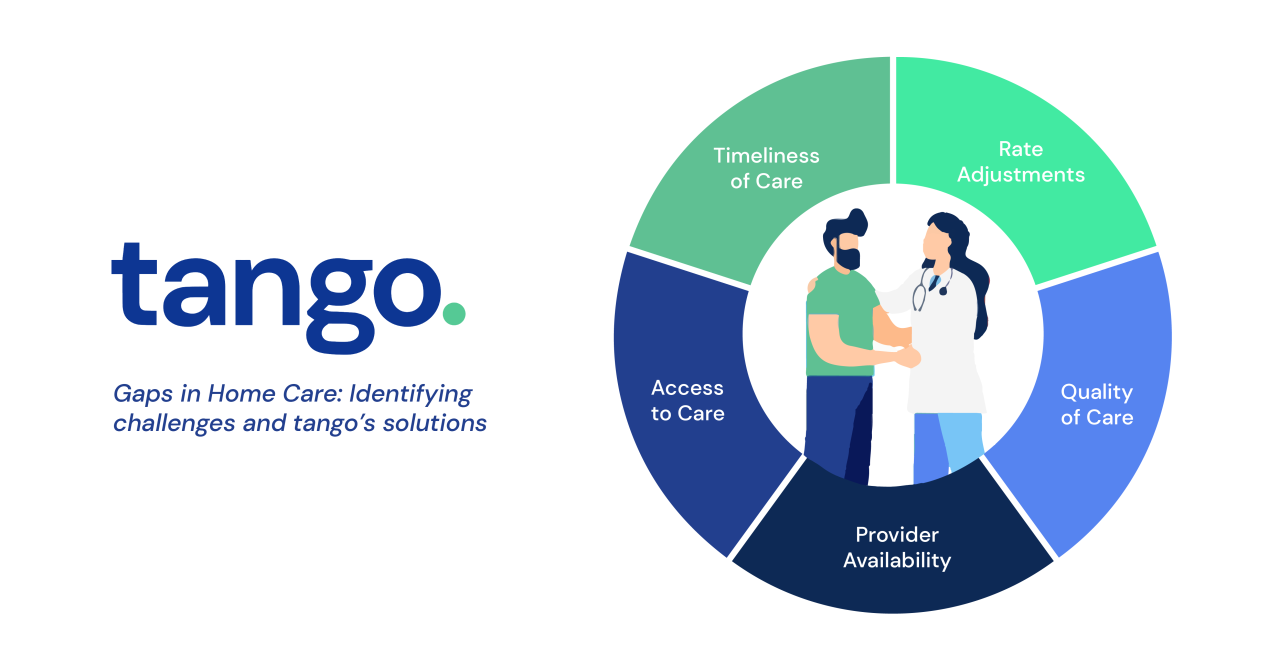
Gaps in Home Care: Identifying challenges and tango’s solutions

Gaps in Home Care: Identifying challenges and tango’s solutions

tango chart
When providing value-based, high-quality, and timely post-acute care solutions in the home, healthcare providers and networks have historically left patients unsatisfied and still in need. Whether it’s the patient experience or foundational service delivery obstacles, there persists a stigma surrounding the reliability of care in the home.

At tango, we empower the home as the site of care in everything we do. While acknowledging the stigma and sometimes a patient’s lack of trust when it comes to receiving post-acute care at home, our Chief Growth Officer, Julie Smith, notes a few of the key challenges currently hindering the expansion of Home Care across the greater health care industry, while also reiterating tango’s place as a critical and unique solution.

Access to Care

Ensuring a patient has access to home care is a fundamental challenge to providing services. Amplified by the COVID-19 pandemic, the United States is facing a shortage of registered nurses (RNs), which directly impacts a home health provider’s reliability of consistent service delivery. On top of that, McKinsey & Company recently reported that 31% of RNs were surveyed as likely to leave direct patient care positions in the next year. While tango does not directly hire patient providers such as nurses, our model encompasses a full network at each client’s disposal, efficiently connecting them with the highest-quality local and national partners.

Another challenge when it comes to accessibility of home care are the disparities in coverage and payment rates across health plans. It can be difficult for a health plan to select the “right” agency for a patient, which often creates an administrative burden. At tango, we have exclusively worked on delivering home care for over 20 years. Our tenure in clinical utilization management (UM), claims processing, paying providers directly, networking and monitoring, and more allows us to reduce fraud and waste within the administrative system while actively creating savings for members.

Quality of Care

Not all home care is provided equally. Across agencies, ensuring that a patient successfully receives home care services can mean vastly different definitions and practices. For some, it may mean providing services as quickly as possible and for others, it could be reducing the likelihood of readmittance to an acute setting. An all-encompassing model of value-based care solutions is where tango comes in. Continuously tracking the outcomes of our home care providers and using that data to learn where the gaps exist allows us to be consistent in our home care model. Additionally, after every service, we measure performance and use specific data to track every interaction with a patient. Through these thorough procedures of care, it is certainly no surprise that tango has a 98%-member satisfaction rate compared to the national average of 72%.

Timely Service Delivery

Timely initiation of care is one of the most important aspects of the care process and is directly tied to quality of care. Time is a clinical standard from the CMS, making it crucial for home health care services to swiftly provide patient care, guarantee improved post-acute care and reduce readmittance and hospitalization. At tango, we have many internal standards for timely service delivery. If our contracted agencies and partners are unable to respond to service requests according to our timeline, we adapt quickly and find another provider to guarantee a patient is taken care of as soon as possible.

While the home care landscape continues to evolve, Julie reiterates that it is our motto at tango, “enabling quality care”, that continues to be at the core of our service delivery. This mission remains true as we continue to develop innovative and unique solutions to mitigate challenges and obstacles to providing accessible, high-quality, and timely home health care services. We look forward to sharing new post-acute care products and partnerships in 2024.

Read Original Article

Open post
Brian Lobley

Q+A with Brian Lobley

Blog:

Q+A with Brian Lobley

tango’s Chief Executive Officer

October 2023 marks one year since Brian Lobley joined tango as our Chief Executive Officer. We sat down with Brian to reflect on his background in healthcare, his first year at tango and how he envisions the future of home care.

Q+A with Brian Lobley

While this may be your first anniversary at tango, you spent almost 20 years working on the payor side of healthcare. How has the transition to tango changed your understanding of what value-based care means from a different part of the healthcare ecosystem?

Brian:In my nearly two decades working within the payor side of healthcare, I developed a deep appreciation for the intricate dynamics of value-based care and aligning stakeholder needs. I have been very fortunate to be involved in some very innovative value-based care models in Philadelphia, and the results we produced to enable better outcomes for members at a lower cost were meaningful, and in my opinion, critical to how we are all working to change the way US healthcare is delivered.
This experience has been invaluable in shaping my understanding of the work that tango is leading today. My transition to tango, which is leading the industry in driving value-based care arrangements across the post-acute continuum, has underscored the multi-faceted nature of value-based care and the importance of collaborative partnerships and alignment.
Today post-acute care, in particular, the home, is not fully enabled as a site of care for people, especially our Seniors in Medicare Advantage plans. The landscape is fragmented, there are many competing sites of service, and while the home is very often the patient’s preferred place to recover, it may not always be utilized, even when it’s a possibility. That’s where tango steps in - our mission is to enable quality care at home across the post-acute continuum.

Reflecting on this past year, what has been the most exciting moment or accomplishment with tango? What challenges do you anticipate as you look to next year?

Brian: I think our re-brand really encapsulates many of our key accomplishments this year as we pivot from being a company that was primarily focused on Home Health care to one that is able to drive and coordinate care across the post-acute continuum with a focus on enabling the home as a primary destination (when it makes clinical sense for the patient).
There are significant challenges in our industry. Home health agencies are facing tremendous labor pressure and there are not enough nurses and other care staff to meet the need. Care is also not being optimized for carriers serving Medicare Advantage members, where as much as 60% of home health referrals are going unstaffed. This means that patients discharged from the acute setting are not getting the critical care they need when they go home, which can lead to suboptimal outcomes such as unnecessary rehospitalization and emergency room visits.
This is why the tango model is so critical. Not only are we working hard to increase access for our members by being a preferred partner to home health agency providers, but our model focuses on working with patients while they are still in the hospital to get them placed with one of our high-quality providers. This ensures timely start of care and that care coordination services are provided during the recovery period to drive the best outcomes for our payors and their members.
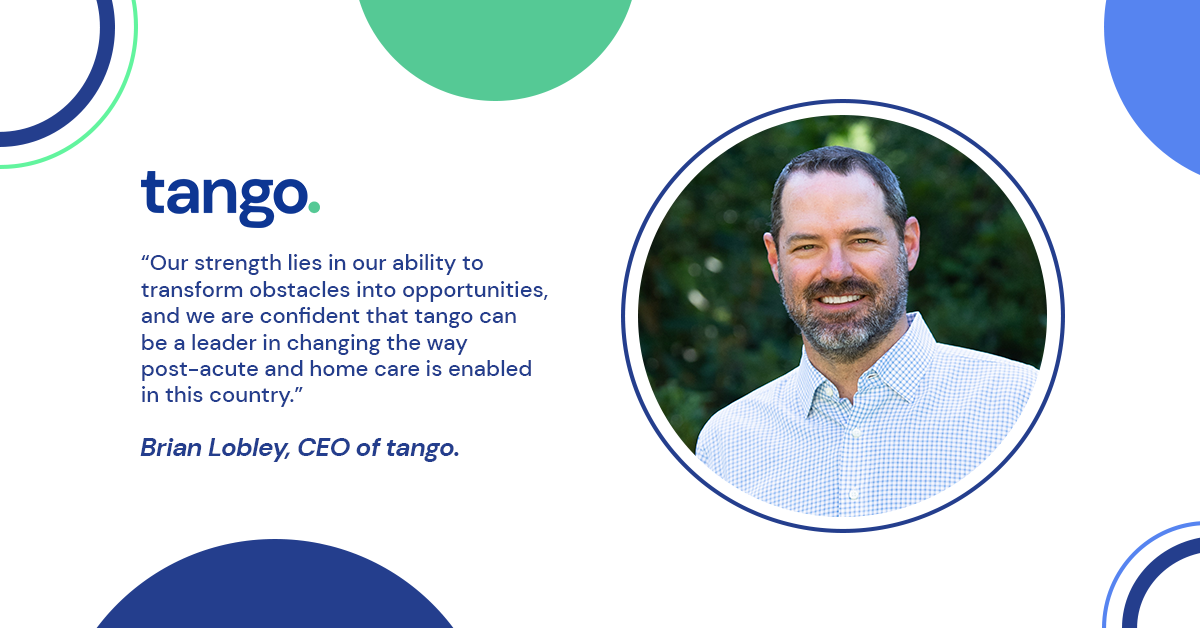
We understand the challenges in our industry are multi-faceted, ranging from regulatory shifts to staffing shortages and increasing demand for home health services. Our distinctiveness lies in our agility and ability to adapt swiftly and work with all key stakeholders (payors, providers, patients) to refine solutions needed to respond to the evolving landscape. Our strength lies in our ability to transform obstacles into opportunities, and we are confident that tango can be a leader in changing the way post-acute and home care is enabled in this country. I’m also really proud of our team and their unyielding focus in helping to position tango to address the unique challenges that are facing the home health care industry.

What does the company name, tango, mean to you?

Brian: Just like in healthcare, the tango is an intricate dance that requires collaboration to be not just successful, but to produce beautiful “outcomes”. The dance’s beauty emerges as two partners connect, conveying emotion and connectedness through their deep attunement to one another. The ‘tango’, like healthcare, encapsulates the essence of how these dancers are working together - communication, adaptability, creativity, innovation, practice, mastery, leadership, and performance.
When seeking a brand to encapsulate this synergy, tango emerged as the fitting choice. Just as the dance requires two partners, our work in the post-acute care ecosystem relies on collaboration between us, payer partners, and providers to ensure patients access high-quality, cost-effective care. tango symbolizes this partnership, reflecting our commitment to working harmoniously to enable better care for patients within this healthcare landscape.

Looking to the future of home care, how you would like to see tango, as well as the home health care industry, innovate?

Brian: tango wants to ensure care the home can be accessible and available for members. Growth in the popularity of care at home is only going to increase as more and more “provider” services move into the home. We need to make sure the supply can meet the demand, the home is optimized as a site of care, and that the value generated from providing care at home is appropriately shared with the providers who are helping us drive better care for our patients.


Read Original Article

Open post
Payers

CMS FINAL RULE 4201-F: What to Know

Blog:

CMS FINAL RULE 4201-F: What to Know

At tango, we know that high-quality home health care services are essential to ensuring optimized post-acute outcomes. In an ever-evolving industry such as healthcare, there are many challenges and changes that companies across the healthcare continuum face in order to ensure everyone can receive access to consistent, timely, and elevated quality of care. These include rate cuts, access issues, and regulatory changes from the Center for Medicare & Medicaid Services (CMS).

This past April, CMS issued Final Rule 4201-F that went into effect as early as June and will continue to have various effective dates for contract years 2024 through 2027. While changes and additional amendments to regulations are not uncommon, these adaptations are important to note within the home health care space and industry at large. Since these CMS policies are aimed at ensuring that beneficiaries have consistent and timely access to medically necessary care, it is important to understand a broader scope of impact across the health care network.

Here, we breakdown 4 of CMS’ recent adjustments in their efforts to increase oversight of Medicare Advantage (MA) plans to further align with traditional Medicare coverage and what that means across the health care service provider network as they begin to take shape into 2024.

Ensuring Timely Access to Care

The Final Rule outlines requirements for utilization management (UM) regarding patient coverage and the practice of prior authorization. New guidelines ensure people with MA plans receive access to the same medically necessary care they would receive in Traditional Medicare. Prior authorization policies are used to confirm presence of diagnosis and to ensure a service is medically necessary. If a beneficiary is undergoing an active course of treatment and switches from traditional Medicare to an MA plan or switches to a new MA plan, the plan will provide a minimum of a 90-day transition period to avoid disruption in care. Such changes will strive to ensure that consistent care is accessible to patients no matter the status of their MA plans.

Protecting Beneficiaries

New measures to protect beneficiaries include the establishment of a Utilization Management Committee to review policies on an annual basis and ensure consistency with Traditional Medicare’s NCDs, LCDs, and guidelines. Aside from UM practices, another protection measure will include countermeasures for misleading marketing practices targeting patients. Moreover, these changes are in-line with efforts to increase transparency and the understanding beneficiaries have relating to their plans and coverage. Notification requirements to beneficiaries means that if a contracted participating provider contract is termed, a good faith effort of at least 30 days’ notice before effective term date is done for the members seen on a regular basis by the terming provider.

Advancing Health Equity

In order to advance best practices concerning health care, the Final Rule will soon begin to require Medicare Advantage organizations to include more substantial cultural and linguistic capabilities within their service directories. Cultural competence on behalf of health care providers is increasingly important to guaranteeing all patients accessibility to the highest quality of care. Reducing health disparities to MA enrollees will actively work to increase communication across health care and further guarantee standardization of care practices.

Improving Access to Behavioral Health

Another aspect of this Final Rule is increasing MA organizational responsibilities to provide adequate behavioral health services within network. While there are many specific new requirements, one to note will require MA organizations to establish programs of care coordination involving community, social, and behavioral health services to mirror levels of accessibility similar to acute care for all enrollees.

New additions and changes to CMS regulations are top of mind for many stakeholders within the home health care industry. At tango, our Chief Compliance Officer, Kimberly Templeton-Garcia B.S.N., CRNI, CHC , has been following the 2023 Medicare Advantage CMS 4201-F changes closely. Kim acknowledged the commitment to evaluating these changes across industry stakeholders, and regarding the Final Rule, that “at tango, we are working with our health plan and provider partners closely to monitor the full impact”.


Read Original Article

Open post
Jay Benn Headshot

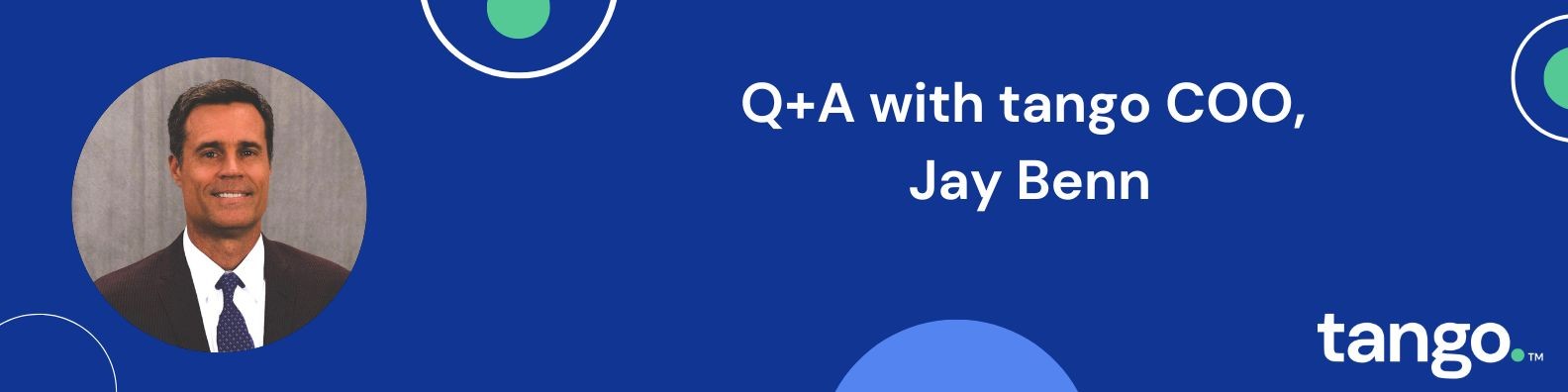
Q+A with Jay Benn, tango’s Chief Operating Officer

Blog:

Q+A with Jay Benn

tango's Chief Operating Officer

Celebrating his anniversary at tango, Jay sat down with us to reflect and discuss tango's success with his leadership.

Q+A with Jay Benn

In the past 3 years with tango, what aspects of the business have kept you engaged and driving success?

Jay:Since joining the tango team, we have been actively focused on several overarching priorities. The first has been developing the strategic relationships with our key provider partners who are the linchpin to providing access and driving quality outcomes for our patients receiving care at home.

Second, we have diligently worked in recent years to innovate our clinical capabilities, become easier to do business with, and expand operational efficiencies so that tango is well positioned to support the significant growth we are experiencing today.

Finally, we continue to advance in building and nurturing a talented and high performing team at tango. While continuing to commit to these aspects of our business, I am especially proud that tango has remained steadfast in keeping at-home patient care at the center of everything it does.

What about tango sets you apart from others when it comes to Home Health Care benefit management?

Jay: tango’s focus on enabling our home health agency partners to provide high quality, cost-effective care for patients through innovative, value-based models really sets it apart from the rest of the industry. We know that the home is often the most efficient and preferred care setting for seniors, but access and transition support can be barriers to allowing seniors to receive care and comfort in their own home. tango’s efforts to drive payment innovation and build high quality home health care networks ensures patients can recover in their own home, and our care coordination program helps manage transitions, improving key outcomes such as admission and re-admission rates, and reducing total cost of care for payors.

What are you most looking forward to with tango and the future of the home care?

Jay: tango and its collaboration with key stakeholders provide a great platform to deliver care much more meaningfully at home. tango is an innovator and leader in driving the enablement of home care for seniors, and I am really looking forward to the role that tango can play in aligning payment incentives with outcomes so that we can change the way our partners are managing their Medicare Advantage business and make the home a safer, more efficient, and high value setting for patients to receive care.


Read Original Article

Open post
Lisa Fisher Headshot

Blog: Q+A with Lisa Fisher, tango’s SVP of Operations and Innovation

Blog:

Q+A with Lisa Fisher

tango’s SVP of Operations and Innovation

"tango has made significant investments in its processes and technology to ensure patients receive the right care, in the right place, at the right time."

August marks Lisa Fisher's three year anniversary with tango. We sat down with her to reflect on how she and tango have evolved over the last three years.

Q+A with Lisa Fisher, tango's SVP of Operations and Innovation

What encouraged you to join tango?

Lisa: Too many of us have had those stories, the ones where healthcare goes wrong, and we say to ourselves, "no one else should have to experience what I just went through". I had one of those stories. Even as an employee of a health plan at the time, it was challenging and confusing. When I learned about tango, I said to myself, "if only I had tango at the time, they would have solved our issue". tango has a strong history of helping patients recover in the home, and I knew I wanted to be a part of that solution - bringing better care to the home.

How has tango evolved since you first joined?

Lisa: When I joined tango we were a single-state company; since then we’ve scaled to several other states and are ready to grow again. COVID-19 really changed the trajectory of illness recovery from being hospital and SNF-centric to home-centric. Seniors and patients are wanting to stay in the home, and we’re well positioned to enable that.

tango has also made significant investments in its processes and technology to ensure patients receive the right care, in the right place, at the right time. These enhancements deliver quicker starts of care, reduced hospital (re-)admissions, and more satisfied patients. Our platforms allow us to scale quickly with satisfied customers.

How has your role changed since you first joined?

Lisa: When I joined tango three years ago, as the VP of Sales, we were a small company with a lot of opportunity. Through my diverse background in strategy and process improvement I was able to fill in some of the gaps we had at the time. While my role in sales was great, I found my passion on the ops side. It allows me to use my analytics, strategy, and process improvement. Not only has my role evolved in the last three years, but I’ve evolved as a person and leader. I now lead an amazing team that is filled with dedicated individuals that show up each and every day ready to solve problems and support the members we serve. I’m grateful for the opportunities tango has given me personally and professionally.

What currently excites you at tango?

Lisa: I’m excited to bring our success to other markets. Being able to save even one patient from having the same experience I had is success. There’s no shortage of opportunity and I thrive on fast moving environments like tango.


Read Original Article

Posts navigation

1 2