

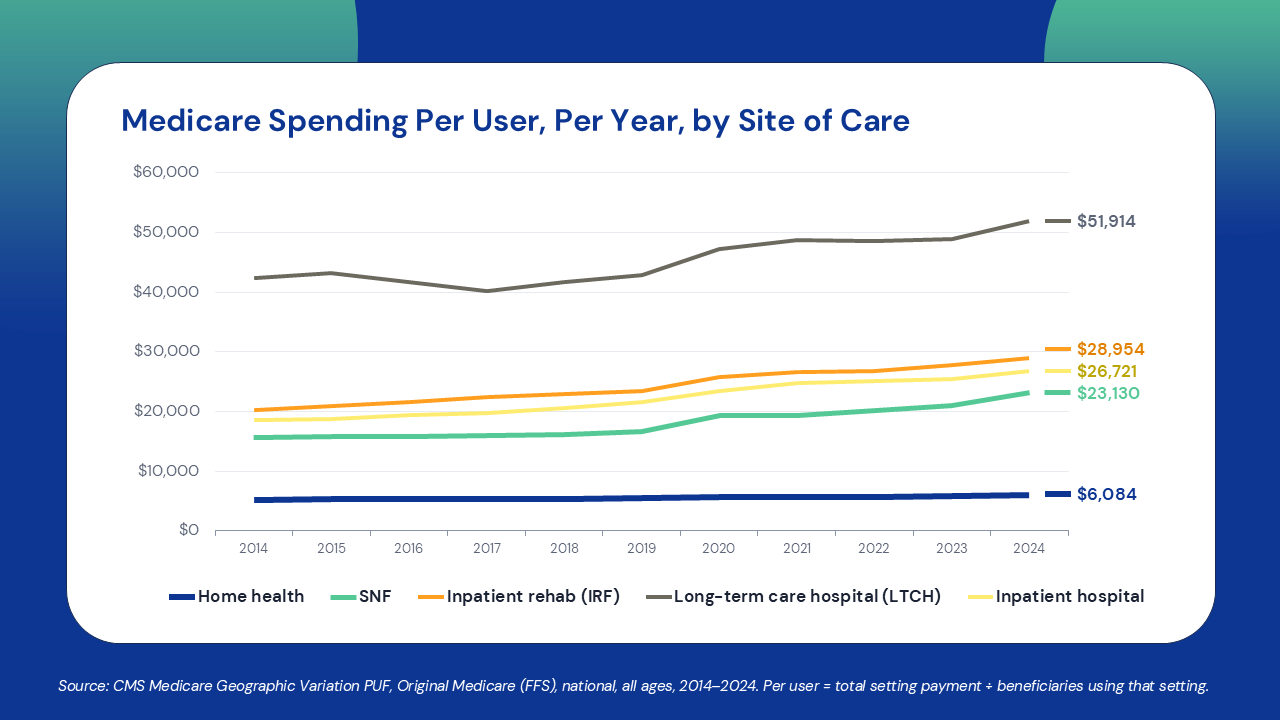
Medicare spends about $6,000 a year for patients who receive home health services. That same patient would cost more than $23,000 if they stayed in a skilled nursing facility (SNF) — nearly four times as much. Inpatient rehabilitation (IRF) runs higher still, and long-term care hospitals (LTACH) even higher than that.
As medical costs climb, the lowest-cost option in post-acute care should be getting easier to use when it is clinically appropriate. Instead, Medicare’s latest data point shows the value of home health is growing, even as the system still lacks a reliable way to make home the default when home is the preferred place for recovery.
The Centers for Medicare and Medicaid Services (CMS) recently updated data on spending and utilization in traditional Medicare for 2024. These data contain information on costs and use across a variety of settings and offer a powerful glimpse of what is driving Medicare spending. The data stretches from 2014 to 2024, giving a decade-long view of trends over time. Because Medicare Advantage plans do not report data in the same way, the clearest view of spending comes from the fee-for-service side. But since Medicare Advantage benchmarks and payment are tied to fee-for-service spending, those trends still matter deeply for plans.
The cost gap is real — and it keeps widening
Between 2014 and 2024, Medicare’s cost per skilled nursing facility user grew 48%. Inpatient rehab grew 43%. Overall Medicare spending grew 39% over that same time. The average home health user? Just 17%.
A SNF stay now costs 3.8 times what home health costs per patient, up from 3.0 times a decade ago. As the most expensive settings are rising fastest, the value of the least expensive one only improves.
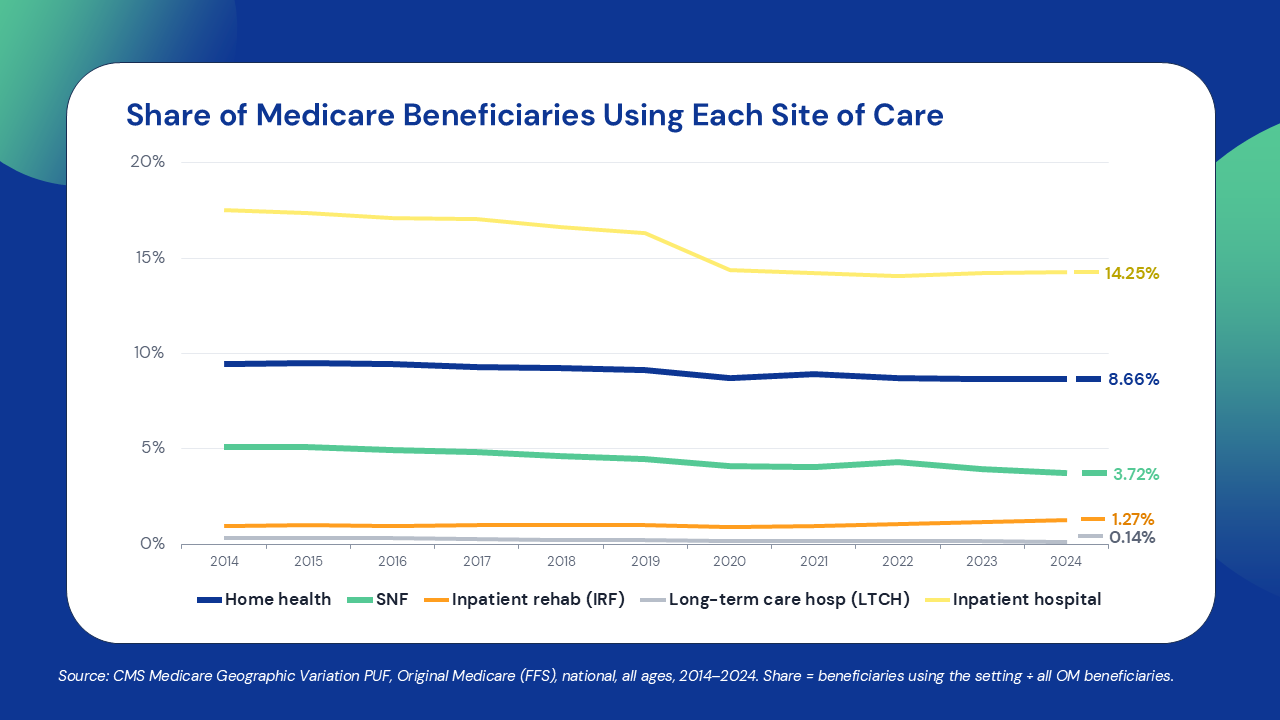
Home health accounts for less than 4% of total Medicare spending. And yet, when a patient leaves the hospital, the system does not always make it easy to choose the lowest-cost appropriate site of care.
To be clear, home health is not suitable for everyone. Some patients are sicker or more fragile and require more than a nurse or therapist visiting a few times a week. For them, a higher-cost, more hands-on setting may be appropriate.
But the spending gap should force health plans to think more critically about how to make the home a better option for recovery when it’s appropriate.
Just over 1 million traditional Medicare beneficiaries had a SNF stay in 2024. If even 10% of them had been cared for at home instead, Medicare could have saved more than $1.7 billion — the difference in cost between the two settings.
On top of the cost and quality arguments, there is the human one: where do people want to recover? For many patients, the answer is home, sleeping in their own bed, eating their own food, surrounded by familiar people and routines.
The problem is the pathway, and tango is different
tango is a delegated, risk-bearing post-acute partner that helps Medicare Advantage plans manage the home health benefit in a way that expands access, aligns incentives, and improves outcomes.
tango steps in when the post-acute decision is being made. It qualifies referrals, confirms eligibility, reviews clinical information, coordinates with providers, and routes patients to high-performing home health agencies. The goal is to enable care, improve outcomes, and lower the total cost of care.
tango also changes the economics for providers. Instead of paying only for volume, tango uses value-based contracts that reward agencies for outcomes. Savings are shared with the providers doing the work, creating a stronger incentive to accept the referral, start care quickly, prevent avoidable readmissions, and support recovery at home.
tango manages the home health benefit for nearly 2 million Medicare Advantage members. The 30-day readmission rate for tango-managed patients runs about 10%, compared to a national average of about 15% — roughly one-third lower. That delivers lower costs and better outcomes, in the same move.
The takeaway
Home health is the lowest-cost setting in post-acute care, it continues getting cheaper relative to every alternative, and patients are asking for it. The only thing missing is the management layer that gets the right people there safely.
Health plans that build it will generate savings and improve quality at the same time. The ones that do not will keep paying four times more for care that, ten to twelve percent of the time, did not need to happen at all.
If you are rethinking your post-acute strategy, we would welcome a conversation.