
Open post
MA Rate Notice - Featured Image

Medicare Advantage Rates Are Tightening. Post-Acute Strategy Matters More Than Ever.

Medicare Advantage Rates Are Tightening. Post-Acute Strategy Matters More Than Ever

The recently released Medicare Advantage (MA) rate notice reinforces a reality health plans already feel every day: profit margins are under increasing pressure, and they must better manage the health of their members to survive.

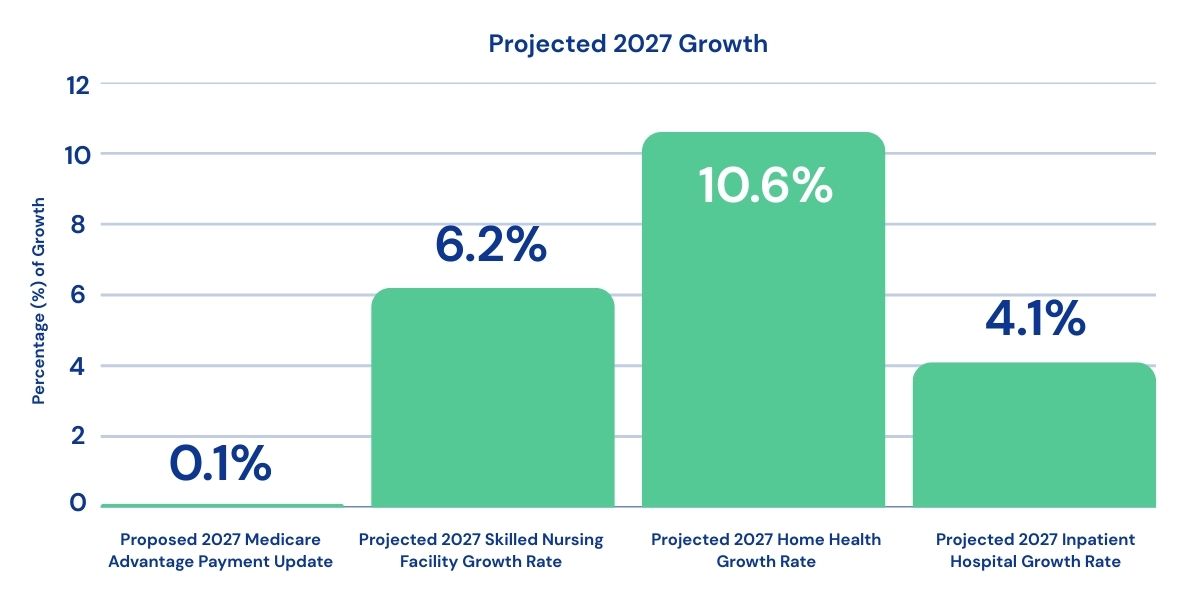
Overall, the Centers for Medicare and Medicaid Services (CMS) proposed a near-flat (0.1%) update in MA payment rates in 2027, even as underlying medical costs continue to rise. At the same time, CMS data shows one area growing faster than every other category in Medicare: post-acute care — particularly home health.

Post-acute spending is driving a disproportionate share of growth in Medicare spending. Home health spending is projected to increase by more than 10%—roughly 2.5x the growth rate of inpatient care. Skilled Nursing Facility (SNF) spending is projected to grow by more than 6%, about two percentage points faster than hospital care. Because MA benchmarks are based on traditional Medicare spending, growth in post-acute Fee-For-Service (FFS) costs directly flows into plan bids, even when rates themselves remain constrained.

As home health utilization grows, home health care access is a struggle for Medicare Advantage enrollees. Workforce shortages, reimbursement pressure, and increasing administrative friction mean agencies are more selective about the patients they accept. In many markets, plans are seeing longer placement times, narrower networks, and rising provider abrasion.

Together, those trends underscore how quickly utilization and dollars are shifting downstream — even as inpatient growth remains comparatively modest — and access challenges are emerging at the same pace.

With more scrutiny to risk adjustment, plans can’t rely on rate tightening or blunt utilization controls to generate savings. Instead, CMS appears to be reinforcing a shift toward care management and total cost control, particularly in high-growth areas like post-acute care. That combination creates a clear signal for Medicare Advantage leaders. Health plans must actively manage post-acute spending or continue to see margins and outcomes to erode.

CMS 2027 Growth Rates
Source: CMS Office of the Actuary, Advance Notice of Methodological Changes for CY 2027

Home health is growing, and it’s not slowing down

According to CMS, growth in home health spending is being driven by both utilization and unit costs, reflecting broader trends of an aging population, pressure to discharge patients sooner, and strong patient preference for recovering at home.

For years, post-acute care has been managed largely through utilization controls like eligibility checks, visit caps, and administrative hurdles designed to limit volume. But those approaches were built for a different era.

Today’s challenge is delivering better care:

  • Are members getting into home health quickly after discharge?
  • Are referrals going to high-quality providers who can prevent avoidable readmissions?
  • Are incentives aligned so agencies are rewarded for outcomes, not volume?
  • Is care being coordinated across settings, or fragmented across vendors?

When post-acute care is treated as a transactional benefit rather than a managed episode, plans lose the trust of patients, providers disengage, and avoidable costs show up later, often as readmissions, ED visits, or extended facility stays.

A shift toward coordinated, value-based post-acute care

Instead, MA plans need a different solution: tighter integration, better care management, and accountability for total cost of care.

This is where tango’s model aligns squarely with the moment. By managing post-acute referrals at the point of discharge, tango reduces placement delays and increases access to high-performing providers.

Rather than relying on utilization management alone, tango actively manages post-acute episodes end-to-end. That means:

  • Improving access by reducing placement delays and directing referrals to high-performing providers
  • Aligning incentives through value-based, episodic reimbursement rather than volume-driven payments
  • Reducing friction for plans and providers by integrating referral management, utilization oversight, and claims into a single delegated model
  • Driving better outcomes through real-time clinical oversight and accountability across the episode of care

For plans, the result is a more sustainable way to manage one of the fastest-growing areas of spend without sacrificing quality or member experience. For providers, it creates predictability, partnership, and incentives that reward good care.

The takeaway for MA leaders

Margin protection won’t come from across-the-board cuts or tighter gates alone. It will come from smarter care delivery, especially in high-growth areas like post-acute care.

Plans that invest now in coordinated, value-based post-acute strategies will be better positioned to absorb cost pressure, improve outcomes, and compete on member experience. Those that don’t may find that unmanaged growth quietly undermines both financial performance and quality metrics.

Home health isn’t just a cost center. Managed well, it’s a lever for better care and a competitive advantage.

Turning Post-Acute Care into a Competitive Advantage

tango partners with Medicare Advantage plans to transform post-acute care from a cost center into a performance driver. Our delegated model improves placement speed, aligns providers around outcomes, and delivers predictable savings, all while protecting member access.

If you’re rethinking your post-acute strategy in light of the 2027 rate notice, we’d welcome a conversation.

Open post
tango-iheart

Leading with Purpose: Brian Lobley on Why Home-First Care Is the Future

Leading with Purpose: Brian Lobley on Why Home-First Care Is the Future

Brian Lobley, chief executive officer of tango, was recently featured on CEOs You Should Know, an iHeartMedia podcast that spotlights executives shaping the future of their industries. The conversation highlighted Brian’s leadership qualities and underscored why tango’s growth, strategy, and impact are resonating across healthcare.

As home-based care moves to the center of the healthcare delivery system, industry leaders are increasingly looking to executives who can navigate complexity, scale responsibly, and keep patients at the center of innovation. Brian’s leadership at tango reflects that moment.

A Leadership Style Built on Impact

During the conversation, Brian reflected on a career that spans technology, strategy, and operations across some of healthcare’s largest organizations, including senior leadership roles at Independence Blue Cross, one of the nation’s largest regional health plans. There, he worked at the intersection of payer strategy, technology modernization, and provider relationships, experience that shaped his perspective on how incentives drive outcomes at scale. What ultimately drew him to tango, he shared, was the ability to see impact more clearly and more quickly.

Brian’s perspective shapes how tango operates today. He described how he emphasizes mission and culture while encouraging teams to continuously improve processes across people, technology, and operations. For example, he starts every meeting with a patient story and personally meets with every new hire.

Brian has fostered a culture where innovation and execution go hand in hand. The result is a company that moves fast without losing sight of why the work matters.

Scaling a Home-First Model That Works

Under Brian’s leadership, tango has grown rapidly by leaning into a simple but powerful premise: when clinically appropriate, patients want to recover at home, and outcomes are better when they do.

On the podcast, Brian described tango’s “home-first” approach to post-acute care, which prioritizes timely, high-quality transitions from hospital to home. By aligning incentives across health plans and providers and operating in value-based payment arrangements, tango helps reduce readmissions, improve access to care, and lower total cost of care. tango prioritizes access, its “secret sauce”, and patients are 30% less likely to be readmitted to the hospital or visit an emergency room if they’re seen at home within two days of a hospital discharge.

tango’s model is scaling quickly. tango has expanded its footprint from four states in early 2025 to 10 states by 2026, growing the number of Medicare Advantage lives it serves while maintaining high standards for quality and member experience.

Recognition That Reflects Momentum

Being featured on an iHeart podcast alongside leaders from across industries is third-party validation of tango’s trajectory and Brian’s role in shaping it. As policymakers, payers, and providers rethink how post-acute care should work and its role in managed care, voices like Brian’s are helping define what comes next.

For tango, the takeaway is clear: the market is paying attention. The challenges in home health—access gaps, workforce shortages, and rising costs—are real. But so is the opportunity to solve them with smarter, value-based approaches that put patients first.

As Brian put it during the interview, healthcare is ultimately a team sport. tango’s continued growth reflects what’s possible when leadership, incentives, and purpose are aligned around getting patients the right care, in the right place, at the right time.


Listen to the Podcast